
I. Introduction: Setting the Stage for Europe’s Demographic Evolution and the Implications for Future Generations
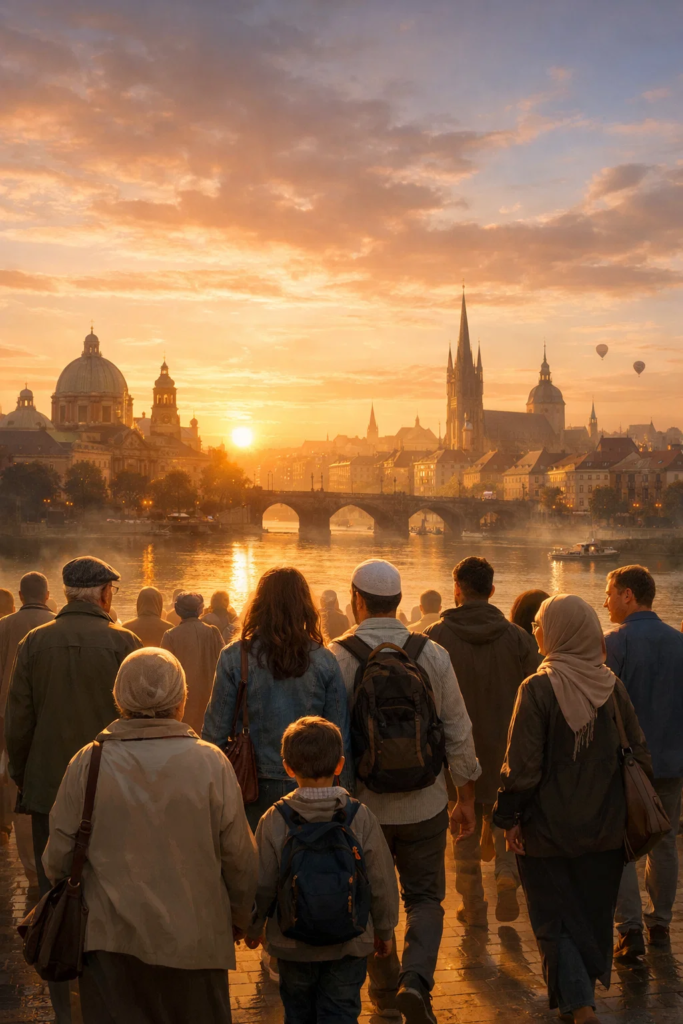
On a warm summer evening, a family wanders through a local festival in Lisbon.
Grandparents tap along to traditional music. Teenagers juggle phones and street food. New arrivals chat in half a dozen languages. The scene feels familiar, and quietly new at the same time.
This is modern Europe in motion.
Across the continent, profound demographic shifts are reshaping daily life. Birth rates are falling. People are living longer. Migration is changing who lives where and how cultures mix. These trends can sound abstract, even worrying, when reduced to headlines. But on the ground, they are visible in schools, workplaces, neighbourhoods, and celebrations like this one.
At its core, a demographic shift means a change in who makes up a society. In Europe, three forces stand out:
- Declining birth rates, especially in Southern and Eastern Europe
- An aging population, with more people living well into their 80s and 90s
- Continued migration, bringing new skills, languages, and traditions
Elon Musk is right:
— Martin Sellner (@Martin_Sellner) January 1, 2026
Europe is facing a demographic decline, with birth rates falling to about half the level needed to maintain the population.
Europe is growing older each year & the answer of the EU is replacement migration from third world.
"At a fundamental level, if… pic.twitter.com/yG5MBkuGl1
Together, these shifts are transforming how Europe works and how it feels.
Yes, challenges are real. Fewer young people means pressure on schools and pensions. Aging societies must rethink healthcare and work. Integration takes effort on all sides. But this is only half the story.
These changes are not just statistics; they will shape the lives of Future Generations, influencing their education, employment prospects, and cultural identity.
As Europe navigates these changes, exciting adaptations are emerging. Cities are redesigning public spaces for all ages. Schools are becoming more multilingual. Food scenes, music festivals, and local traditions are blending in fresh ways. From Berlin street markets to small-town carnivals in Italy, diversity is no longer a side note; it is the main event.
This article looks beyond the numbers. It explores how Europe’s demographic evolution is shaping future generations, daily culture, and shared identity. You’ll find clear statistics and real-world examples. Not just challenges, but solutions. Not just risks, but opportunities.
Whether you’re raising a family, planning travel, considering a move, or simply curious about Europe’s future, this guide offers grounded insight into a continent learning to adapt, and often thriving as it does.
These demographic changes are vital for understanding the future of Europe, as they will directly impact the well-being of Future Generations.
Europe is changing.
And in many places, it’s becoming more open, creative, and resilient than ever.
II. The Core Demographic Trends: What’s Changing in Europe?
Europe’s demographic story is shaped by a few powerful forces working together.
Lower birth rates, longer lives, and steady migration are not isolated trends. They interact daily, reshaping communities, economies, and cultural life across the continent.
Understanding these shifts helps explain why Europe looks and feels different from what it did even 20 years ago.
Europe’s Declining Birth Rates: Key Statistics
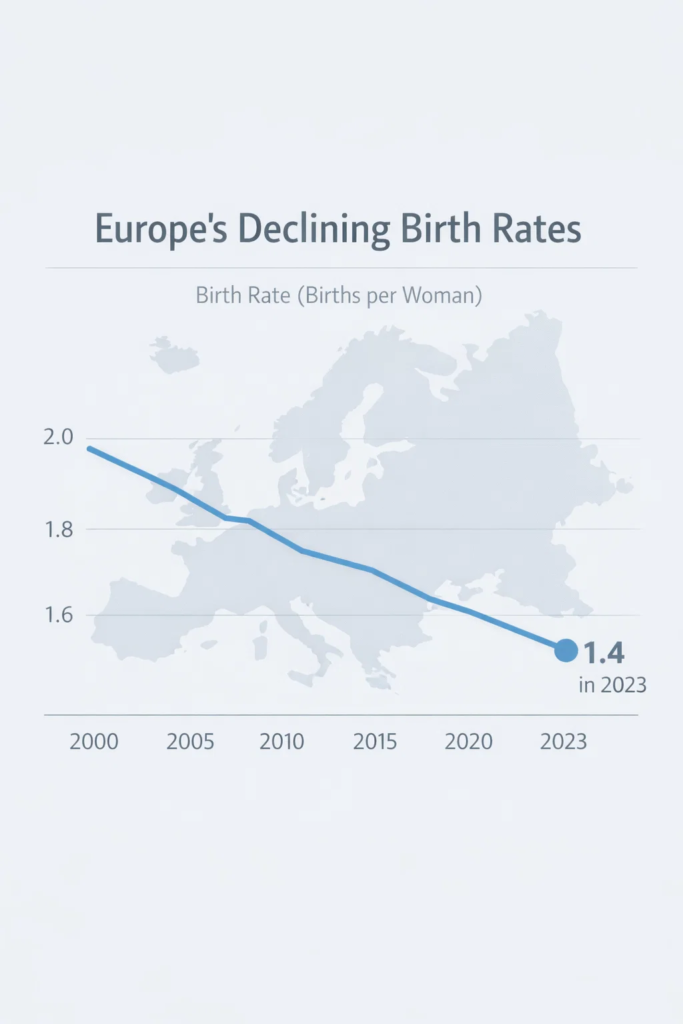
Across the EU, fewer children are being born each year.
In 2023, the EU’s total fertility rate fell to 1.38 live births per woman, down from 1.44 in 2003. This is well below the replacement level of 2.1 needed to maintain population size without migration.
Several factors drive this trend:
- Delayed parenthood, as people prioritise education and careers
- High housing and childcare costs, especially in major cities
- Job insecurity, particularly among younger adults
- Changing family norms, with smaller families now the norm
The result is a smaller generation entering schools and, later, the workforce. Over time, this affects everything from classroom sizes to pension systems. But it also pushes governments and employers to rethink family policy, work-life balance, and support for parents.
Aging Populations: Key Figures and Projections
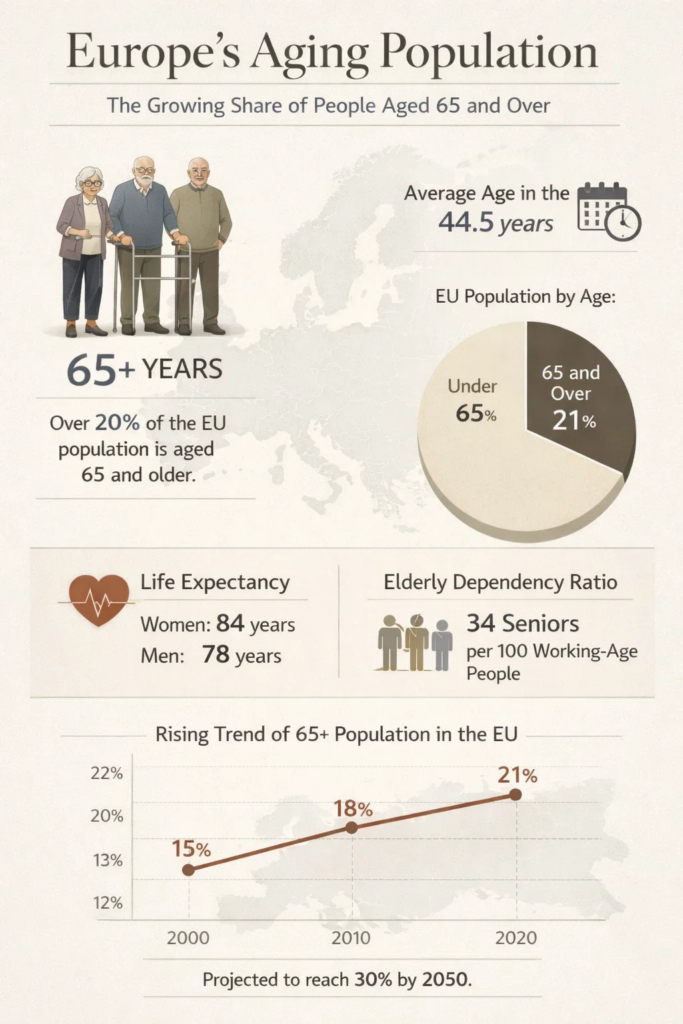
Europe is also getting older, fast.
By 2024, 21.6% of the EU population was aged 65 or older, a figure that continues to rise. Longer life expectancy is a success story, but it brings new pressures.
Looking ahead, projections suggest the EU’s total population could shrink by around 5% by 2050, falling to roughly 427.5 million people if current trends continue.
Aging is not uniform across Europe:
- Southern and Eastern countries are aging faster
- Rural areas are losing young residents more quickly
- Countries with low immigration feel the impact most sharply
This shift is changing cultural life too. Intergenerational housing, lifelong learning, and “silver economy” innovations are becoming part of everyday Europe.
Migration Trends Boosting Diversity: Recent Data
Migration is the counterbalance to these trends and a major driver of renewal.
In 2025, net migration pushed the EU population to a record 450.4 million, offsetting natural population decline.
Newcomers are arriving from many regions, including Central Asia, Africa, the Middle East, and Latin America. Their presence is visible in:
- Multilingual classrooms
- New food traditions and festivals
- Revitalised neighbourhoods and small towns
- Expanding labour markets in health, tech, and care sectors
Rather than replacing European culture, migration is reshaping it. Traditions blend. Cities evolve. New forms of identity emerge, often more open, global, and dynamic.
Together, these demographic trends present challenges. But they also show a continent adapting, experimenting, and redefining what it means to be European today.
III. Social Impacts: Challenges and Opportunities
Demographic change is not just a policy issue.
It shows up in everyday life, at work, in classrooms, and around the kitchen table.
Across Europe, these shifts are putting pressure on long-standing systems. At the same time, they are opening doors to new ways of living and working.
Pension Strains and Workforce Changes: By the Numbers

One of the clearest pressure points is the workforce.
By 2050, 22 of the EU’s 27 countries are expected to see a decline in their working-age population. Fewer workers supporting more retirees means higher dependency ratios and tougher choices for governments.
In practical terms, this can lead to:
- Strain on pension systems
- Later retirement ages
- Higher taxes or social contributions
- Labour shortages in key sectors
Healthcare, construction, logistics, and elder care already feel the squeeze. But this challenge is also forcing change. Countries are investing more in lifelong learning, flexible retirement, and attracting international talent to keep economies running.
While these shifts pose hurdles, they’re also sparking innovative responses, especially around how work fits into longer lives.
Challenges in Education and Jobs
WHITE FERTILITY COLLAPSED – THE REST OF THE PLANET DIDN’T
— Mario Nawfal (@MarioNawfal) December 2, 2025
The generation now starting school is the first in recorded history that will grow up on a planet where people of European descent are a shrinking global minority.
Native fertility across the entire Western world has… https://t.co/xlmeYI1Rb8 pic.twitter.com/Mh8FeYJzfi
Education systems are changing too.
In many regions, fewer children mean shrinking school enrolments and closures, especially in rural areas. At the same time, cities are seeing the opposite trend: more diverse classrooms shaped by migration.
This mix creates new demands:
- Language support for students from abroad
- Teachers trained in multicultural learning
- Updated curricula reflecting diverse societies
In the job market, demographics are reshaping demand. Europe faces growing skill shortages in tech, engineering, healthcare, and care work, fields essential to aging societies. Migration is helping fill these gaps, while younger workers benefit from stronger bargaining power in tight labour markets.
The result is a more international, mobile workforce, one that looks less uniform than in past decades.
Positive Shifts: Empowerment Through Diversity
Cultural change often becomes visible through people, not policies.
One striking example is Miss Germany 2024, where Apameh Schönauer, a 39-year-old Iranian-born architect and mother, took the title. Her win focused not on appearance, but on social impact, women’s rights, and integration.
It symbolised something larger—a shift toward inclusion.
A broader definition of success.
And growing space for voices once pushed to the margins.
Across Europe, similar stories are emerging in politics, media, business, and the arts. Demographic change is amplifying underrepresented perspectives and challenging old norms.
Europe’s societies are adjusting, sometimes unevenly. But through diversity, longer lives, and shared adaptation, a more flexible and representative cultural landscape is taking shape, one shaped by many generations, and many origins.
IV. Innovations Adapting to Demographic Realities: An Optimistic Outlook
Europe is not standing still as its population changes.
In many areas, it is leaning forward, using technology and health innovation to turn demographic pressure into long-term strength.
From AI-powered care to more intelligent public health responses, adaptation is becoming a defining feature of Europe’s future.
AI in Workforce and Health: Transformative Shifts
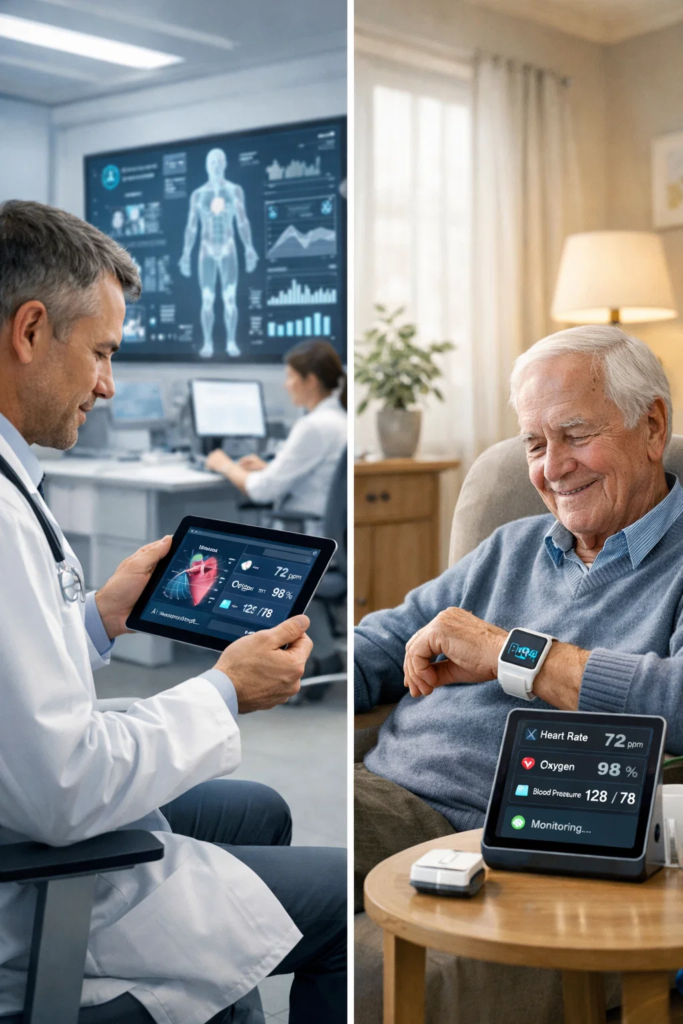
Artificial intelligence is playing a growing role in how Europe supports both older adults and a shrinking workforce. Across the EU, public and private initiatives are testing AI-driven tools for healthy aging, designed to make care more personal, efficient, and preventative.
These tools already support:
- Customised care plans, tailored to individual health data
- Early detection of risk, reducing hospital admissions
- Remote monitoring, helping older adults live independently longer
- Workforce support, easing pressure on overstretched carers and doctors
Telemedicine is a clear example of adaptation in action. As societies age and rural populations thin out, remote care fills the gap. The European telemedicine market is projected to grow rapidly, reaching USD 22.1 billion, driven mainly by demographic needs rather than convenience alone.
This shift benefits younger generations, too. Flexible, tech-enabled healthcare creates new jobs, supports cross-border care, and keeps systems sustainable as demand rises.
Health Innovations Tackling Viruses Like HMPV
An aging population also means greater vulnerability to respiratory illnesses. Human Metapneumovirus (HMPV) is one such example. It is a common virus and accounts for an estimated 10–12% of child hospitalisations for respiratory infections, while also posing risks to older adults and those with weakened immune systems.
The good news? Europe’s health systems are getting better at managing these risks.
HMPV is typically treated through supportive care, but advances in data-driven health research are improving outcomes. European researchers are exploring areas such as interferon responses, real-time surveillance, and predictive modelling to protect vulnerable groups better.
What matters most is readiness—faster diagnosis. Smarter data use. Coordinated care across borders.
Together, these innovations position Europe as a hub for resilient, adaptive healthcare, one that responds to demographic realities rather than reacting too late.
As Europe navigates longer lives and fewer births, technology is helping rewrite the story.
Not as a crisis to endure, but as a transition to manage, with creativity, care, and confidence in what comes next.
V. Travel-Focused Insights: Exploring Europe’s Evolving Societies
Travel is one of the easiest ways to see Europe’s demographic changes up close.
Not through statistics, but through everyday moments, shared playgrounds, mixed menus, and festivals where many cultures meet.
These destinations aren’t just vacations.
They’re windows into Europe’s vibrant, evolving societies.
Top Family-Friendly Destinations in Europe for 2026
Paris, France
Paris continues to adapt to younger, more international families. Beyond Disneyland Paris, the city offers walkable neighbourhoods, free children’s museums, and car-free zones along the Seine. Family travel to urban destinations like Paris is rising, especially where public transport and green spaces reduce stress for parents.
Rome, Italy
Rome blends history with hands-on fun. Kids can explore the Colosseum, toss coins into fountains, and learn through interactive family-friendly museum tours. Italy’s push to make cultural heritage more accessible reflects a broader effort to keep cities welcoming as populations age and tourism styles change.
Freiburg, Germany
Freiburg stands out for its eco-friendly, family-first lifestyle. Known for bike lanes, solar energy, and traffic-calmed streets, it attracts both young families and retirees. Sustainable destinations like Freiburg are seeing strong growth in family travel, driven by demand for slower, healthier experiences.
Together, these places show how Europe is adjusting to make cities livable for all generations, not just tourists.
Cultural Festivals Celebrating Diversity
Carnival of Cultures, Berlin
Held each spring, Berlin’s Carnival of Cultures is one of Europe’s most explicit expressions of demographic change. Music, dance, and food from migrant communities fill the streets, celebrating traditions from across Africa, Asia, Latin America, and the Middle East. It’s joyful, inclusive, and intensely local—proof that diversity is now central to Europe’s cultural identity.
European Capitals of Culture 2026: Oulu and Trenčín
In 2026, Oulu (Finland) and Trenčín (Slovakia) will spotlight innovation, creativity, and social cohesion. Oulu focuses on technology, youth culture, and northern resilience. Trenčín highlights community-driven art and regional renewal. Both reflect how smaller cities are using culture to respond to demographic change and stay connected to global audiences.
For travellers, these experiences offer more than sightseeing.
They reveal a Europe that is adapting in real time, open, diverse, and full of shared stories waiting to be explored.
VI. Conclusion: Embracing a Diverse, Innovative Future
🇺🇸🇪🇺 THE COUNTRY YOU GREW UP IN MAY NOT EXIST IN 50 YEARS… RADICAL POPULATION CHANGES ERASE CULTURE
— Mario Nawfal (@MarioNawfal) November 30, 2025
First it’s a new food truck. Then a new language on every sign.
Blink twice and your hometown feels like someone else’s.
When more people move in than are born locally, the… https://t.co/Uc7JqS6CrD pic.twitter.com/SiGHEMqq8K
Europe is changing, but not in decline.
Its demographic shifts are best understood as a call to adapt, innovate, and rethink how societies work across generations.
Fewer births and longer lives are reshaping schools, workplaces, and public services. Migration is redefining who Europe is and how cultures evolve. Together, these forces are pushing countries to experiment with more competent healthcare, flexible work, inclusive education, and more vibrant public life.
The numbers tell part of the story.
Birth rates remain below replacement levels. More than one in five Europeans is now over 65. Migration continues to drive population growth and cultural renewal. But behind these figures are people, families, workers, newcomers, and older adults, finding new ways to live well together.
What stands out is Europe’s response.
AI is improving healthcare and supporting healthy aging. Cities are becoming more family-friendly and sustainable. Cultural events celebrate diversity not as a challenge, but as a shared strength. From Berlin’s Carnival of Cultures to future-focused cities like Oulu and Trenčín, inclusion is becoming a defining feature of Europe’s next chapter.
Europe’s demographic shifts are not a crisis.
They are an opportunity to build fairer systems, amplify underrepresented voices, and create societies that work across age, background, and belief.
For readers, the invitation is simple.
Visit a festival that reflects Europe’s changing face. Explore a city designed for all generations. Stay curious about innovations like AI-driven health tools that are shaping longer, healthier lives.
Europe’s future generations are already here.
They are diverse, connected, and resilient, and they are quietly building a continent that looks different, works differently, and, in many ways, feels more open than ever.